
Welcome to the August Edition of KLM Spatial’s Industry Updates.
Cost of planning new suburbs skyrockets as
approvals collapse
Melbourne housing: Planning costs for new suburbs skyrocket
Things that frustrate us everyday are beginning to get more recognition in the mainstream media, for example in The Age on 27th of July. They highlighted:
- PSPs now cost $6m to deliver, up from $700K five years ago.
- PSP approvals are down to an average of 2 p.a. from ~10 15 years ago.
- VPA funding has remained relatively stable at $12-$14 million over the last decade, reflecting political agendas, red tape & system blockages.
- Villawood Properties Executive Director Rory Costelloe says the target should be 60/40 infill/greenfield to meet long-term trends. This remains post-pandemic, however resource priority is towards infill projects rather
than growth areas. - Rory Costelloe: “there’s no market for 70 per cent infill”.
- The journalist doesn’t necessarily agree by writing Melbourne has been “creating one of the most sprawling, car-dependent metropolises in the world”.
- The Government has committed to reducing PSP timeframes by one third, as part of its 10-year Greenfields plan, however we are yet to see how they propose to achieve this.
New Australian Standard for Trees on Development
Sites
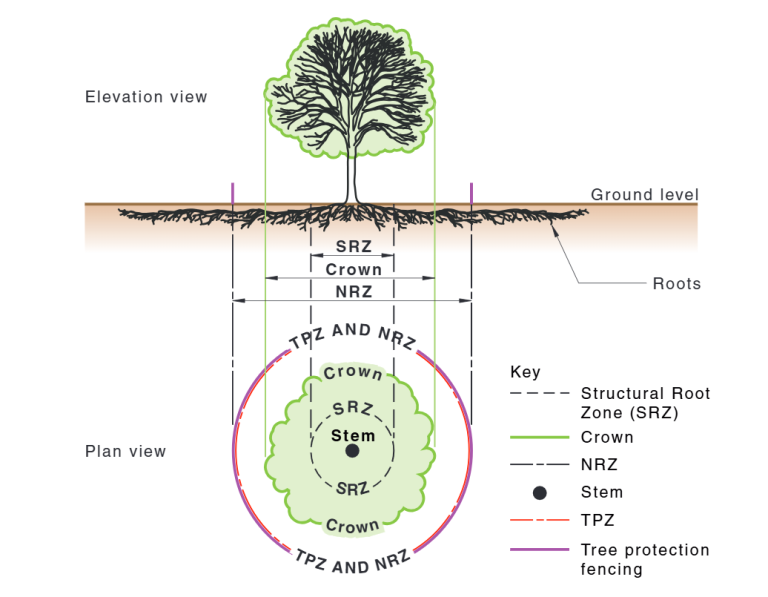
Standards Australia published a second edition to AS 4970-2009 for the Protection of trees on development sites, in May 2025 referred to as AS 4970:2025.
Australian Standards are voluntary unless they are referenced in legislation or called up in contracts. However this standard is generally considered the go-to for assessing tree impact.
The update provides clarification of the protection zones and adds a third category for encroachment into the “notional root zone” (NRZ). Minor NRZ encroachment is up to 10%, moderate is 10-20% and major is >20%.
We therefore believe Arborist consent formerly at 10% encroachment now becomes 20%, however this should be verified with the project Arborist. In our limited dealings with Arborists on this update so far, they are not retrospectively applying the new standard to old permits or Reports. They believe authorities will largely adopt the same view, however there will be some inconsistency with the transition.
Contact Major Projects if you are interested in joining a briefing from an Arborist about the transition to the new standard.
Planning for Productivity
Planning Institute of Australia, submission to the Economic Reform Roundtable, July 2025.
PIA made a submission to the Australian Treasury Department ahead of the Economic Reform Roundtable over 19-21 August 2025.
PIA’s submission aims to highlight the critical role that planning systems play in shaping housing, infrastructure and broader economic performance. It focuses on planning’s enabling role within the housing production system, reflecting the Roundtable’s
anticipated focus on improving housing system productivity.
It’s key productivity messages are:
- Simplifying approvals through strategic planning, which leads the system with
certainty, coordination and direction, so that development assessment can be
streamlined. - Aligning land use with infrastructure, for integrated transport, utilities and social
infrastructure that makes efficient use of public money. - Facilitating urban agglomeration, with well planned near jobs and services leading to
increased productivity, wages and innovation. - Managing risk and building resilience, for avoidance of high-risk hazard areas, implementing climate adaptation and reducing the cost burden of disaster recovery.
PIA’s wish list for reform action is:
- Accelerate well-located homes with strategic planning (including the potential for
‘national zoning’ and an infill best-practice model) - Digitise the planning system (with a national dashboard and improved data sharing)
- Improve coordination and efficiency (including to streamline state agency referrals and set national benchmark standards)
- Link infrastructure and land use outcomes (including with more trunk infrastructure in growth areas / ‘housing corridors’)
- Address workforce shortages (including support for tertiary planning programs and upskilling)
- Targeted tax and finance reforms (including reviewing development taxes and setting a national target for social and public housing).
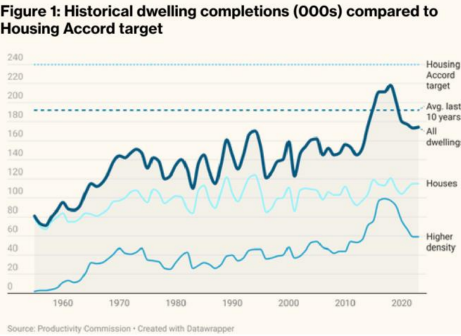
PIA highlights that Australia is not on track to meet the National Housing Accord target of 1.2 million homes by 2029. Among the many factors that are currently choking productivity, it acknowledges that there is a “post-approval bottleneck”, where many projects are yet to/will not reach commencement.
YIMBY highlights Planner – Productivity Crisis
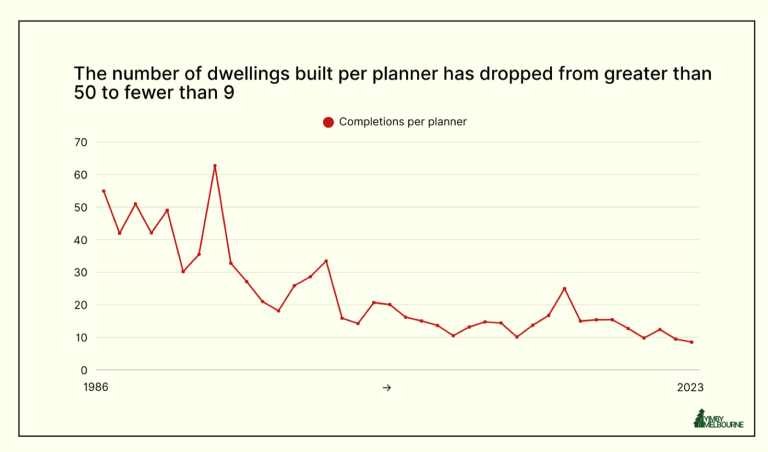
This is some research by the privately funded Yes In My Back Yard (YIMBY) Melbourne Advocacy Group, comparing the growth of the planning workforce with housing delivery data over four decades.
Their core message being – planner productivity has collapsed from 54 homes per planner in 1986 to fewer than 9 today. The Planner’s representative body PIA, has dismissed the trend calling for more planners to deal with increasing complexity across the system.
However YIMBY highlights planner productivity has collapsed six times more than construction workers, therefore loss of productivity is attributed to planners blocking approvals, and there being a desperate need for system reform to be a housing enabler.
Some of the productivity trends align with major changes to Victoria’s planning system and significant economic events, for example:
- The rate has remained relatively steady since the introduction of the new format planning schemes in ~2001. As I’m told, this led to a virtual doubling of the planning force in quick succession because significant opportunities
opened up for new private planners. - The new format schemes allowed a proliferation of new controls in the zones and overlays, which increased complexity and permit requirements.
- Developers increased using private planners to navigate the labyrinth of new planning controls and battle against councils (some also employing their own planners in-house).
- The Global Financial Crisis in 2008 lead to significant layoffs of planners overseas, who sought new opportunities in Australia, where economic stimulus measures were rolled out by federal and state governments.
- The height of planner productivity in the last 20 years, coincides with the peak of Melbourne’s apartment boom.
- The speed and breadth of new direct and indirect land use planning controls introduced over the last 10-20 years has only exacerbated the issue.
- PREDICTION: post-pandemic material and labour cost escalation leading to lower commencements, will ensure a low baseline remains in the short-term.
Victorian Building Activity, March 2025
New data from the ABS and released by the PCA, shows that 14,266 dwellings were completed during this quarter, up 231 completions in the last quarter, yet still short of the national goal set for Victoria of 15,392. Meanwhile, work on 15,503 dwellings commenced in the last quarter, up 3200 from the last quarter (Christmas slow down) and 1166 from 12 months ago.
Get married to buy a house? It’s more like avoiding divorce to keep one
The rate of divorce in Australia has fallen to its lowest levels since the mid-1970s. In 2023, there were 2.3 divorces for every 1,000 residents compared to 6.3 in 1976. More recently getting squeezed by the cost-of-living crunch and in the midst of a housing crisis, research suggests more couples with their differences are staying together in a home they own. Buying or renting most properties is becoming out of reach for average Australians, particularly in the case of single income serviceability for a loan.
A new home in 20 days, promises the ‘Henry Ford’ of modular housing
What is modular housing and how Grove modular builders are creating affordable housing.
Pakenham-based modular builder Grove, is preparing to complement its production line of health and education sector moveable pods, to take on prefab homes in response to the affordable residential crisis.
Grove could potentially crank out up to 1,000 homes per year, servicing the land lease community (LLC) market and offering product with no-frills design, it’s CEO Brenton Grove said.
“Essentially, what we’re trying to do is to be the Henry Ford [of residential construction] – ‘you can have any colour, so long as it’s black’ – because the only way we can pass value on is to get people into homes,” he told The Australian Financial Review.
LLCs are increasing in popularity with retirees looking to cash in on their long-held family home. Recent CBRE estimates put the number of land lease sites operating around the country at around 40,000, with another 15,000 to 20,000 under development. Approximately one quarter are in Victoria.
CBRE says residents are paying $700,000 to $1.2 million for new designs, compared to $400,000 to $800,000 for the older models. However Grove says it comes in well below those estimates.
Its two-bedroom, 127 sqm home can be constructed in just 15 days with a price tag of $298,000.
“It’s the Costco model, where any value we’re able to extract from efficiency, the supply chain and up and downstream partners, we will always pass back to the consumer, so long as we can continually add more value.”
Rate adjustments to Development Services Schemes
Melbourne Water has announced that it will increase rates for their Development Services Schemes (DSS) from 30 September 2025.
What to expect for 2025:
- Most of the 121 active DSSs will see rate increases.
- Some schemes may require multi-year increases, capped at 25% annually.
- Developers can lock in current rates by paying project contributions within three months of receiving an Offer and requesting MW consent to the works for Statement of Compliance (SoC) within 18 months.
- Failure to achieve SoC in 18 months results in a top up contribution request, being the difference between two rates.
- Dispensation may be sought within the 18 months from paying a ‘top up’ rate, if there has been a non-prescribed delay outside the control of the Owner/contractor. A further time limit will be set.
What this means is that Offers received to date and all Offers received prior to September 30, 2025 will need to be accepted and contributions paid within the 3-month time limit to ensure that the lower rate is payable.
Contact KLM’s Engineers, for any queries.
Cementing Victoria’s Quarry Planning And Approvals
An Extractive Resources Joint Ministerial Statement from Minister for Energy and Resources Lily D’Ambrosio and Minister for Planning Sonya Kilkenny, is set to provide new measures to fast-track quarry approvals in Victoria. The inclusion of Strategic Extractive Resources Areas in state policy will also guide where new quarries can be established.
The Government identifies Victoria’s quarries as a key component of facilitating significant new housing growth. It says one modest size home typically requires 250 tonnes of rock and sand!
