
VICTORIAN LABOR CABINET RESHUFFLE
- Colin Brooks appointed Treasurer and Minister for Industrial Relations.
- Tim Richardson appointed Minister for Local Government, Consumer Affairs and Renters.
- Nick Staikos appointed Minister for Housing, Building & Precincts, Homelessness & Seniors.
- Michaela Settle appointed Minister for Water and the Minister for Rural and Regional
Development and will remain the Minister for Agriculture. - Sonya Kilkenny appointed Minister for Prevention of Family Violence, while retaining her roles as Attorney-General and the Minister for Planning.
- Enver Erdogan appointed as Finance Minister.
Source: UDIA, Victoria
VICTORIAN HOUSING STATEMENT
UDIA is putting the Carroll Ministry on notice to address elements of the housing crisis overlooked by his predecessors. The Housing
Statement and Industry Partnership need recalibration in order to listen and act on industry advice.
UDIA is already taking action advocating for the following:
- Fast-tracking development growth areas, restoring a reliable pipeline of development-ready land
- Removing prohibitive property taxes & charges that discourage investment. UDIA is vocal about making WGT go first
- Recalibrating housing targets to better reflect market demand, development feasibility & realistic delivery capacity
- Accelerating investment, enabling infrastructure in the fastestgrowing communities.
Source: UDIA, Victoria
Housing Statement snapshot
- Victoria is well off its 800,000 homes in 10 years target
- Less than 55,000 homes were completed in 2025/26
- PSP delivery is still too slow Property taxes are still too high
- WGT is a failed tax
- VCAT just ruled that the SRO was not entitled to $36m in WGT from the Kingswood Golf Club rezoning
FASTER APPROVALS FOR DATA CENTRES VS HOMES
Aussies Sidelined by New Industry
The Housing Industry Association has raised concerns about housing projects being displaced by data centre developments. There is advocacy to ensure land for new housing isn’t acquired by data centre projects, seen in Geelong’s Northern growth corridor. Simon Croft says the sector is being given “preferential planning treatment” that needs to be “called out”. Whilst he doesn’t oppose data centres, he notes that the nation’s biggest challenge right now is building more homes and this should be “afforded the same urgency”.
- The HIA says data centres are going on prime land at the expense of homes Instances of “preferential planning treatment” need to be called out.
- A multi-hectare data centre site could be approved faster than a single home
LABOR PLANNING REFORMS
Since the Townhouse Code was introduced in March 2025, applications for homes have surged by almost 50% (4,800 to 7,000).
Most Applications:
- Monash – 515 homes (51% increase from 2025)
- Merri-bek – 452 homes (39% increase)
- Banyule – 402 homes (98% increase)
- Darebin – 345 homes (63% increase)
Planning permits in middle suburbs now at 3,100 from 2,000 Townhouse code is a planning pathway fast-tracking approval for duplexes, townhouses and low-rise apartments up to 3 storeys. Setting clear standards for good development in terms of access to sunlight, tree coverage, open space and better layouts with well sized rooms and protection from overlooking. If projects meet these standards it can undergo the planning system faster meaning houses
can be built sooner. This code got voted to be scrapped last year by the Liberals “labour has the plan to build more home and make housing more affordable”.
Victoria is becoming the townhouse capital
- Townhouse and Low Rise Code was introduced in March 2025
- Applications have jumped from 4,800 to 7,000
- Middle ring applications are up from 2,000 to 3,100
Regional Victoria is also benefiting:
- Greater Geelong 664 home (83% increase)
- Greater Bendigo recording 166 homes (207% increase)
YIMBY COMMISSIONED SUBURB ANALYSIS
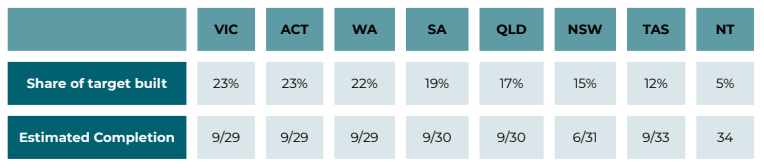
Melbourne is the only Capital allowing medium density housing on most of it’s residential land. Melbourne is an outlier 4 years from the pledge to wind back planning restrictions in order to ease the housing crisis. A site is “Restricted” if it’s capped at 2 storeys, heritage protected, zoned for detached housing only, or otherwise designated low density. The National Housing Accord was created, in part to address zoning laws. The Government’s target is not on track,
set to fall short of 1M. No state is on track with VIC, WA & ACT out performing the others.
Melbourne is least restricted with 45% of its residential sites
CONSTRAINTS:
Hobart: 97%
Adelaide: 92%
Darwin: 88%
Perth: 8%
Brisbane: 86%
Sydney: 81%
Canberra: 74%
CHARTER KECK CRAMER
The Invisible 45% ‘Next Time Buyers
Housing commentary focuses on First Home Buyers and investors, as they are easy to measure. For the past 20 years buyers who are existing homeowners that re-enter the market are the engine of housing liquidity and a lead indicator of supply, determining how much established stock is released, how prices are established across suburbs, dwelling types and price bands. Implications of this cohort being the largest in the market are
important as the government seeks to address the housing crisis. When Next Time Buyers stop moving the market become illiquid this can be due to a range of things, but when the Next Time Buyers are active the market experiences more listings, better prices and more completion in middle and upper price bands. Investors’ relationship with unit approvals was more persistent than with houses. This is consistent with Investors buying into apartment and townhouse projects already in the pipeline, rather than initiating new detached-house approvals.
SHARE OF THE MARKET:
Capitial cities, L20Y
Next Time Buyers:
37.8% – 50.0%
First Home Buyer:
12.8% – 30.6%
Investor:
20.4% – 44.4%
Endured the GFC, APRA lending crackdown, HomeBuilder, 13 consective rate hikes
OLIVER HUME – JULY REPORT VICTORIA
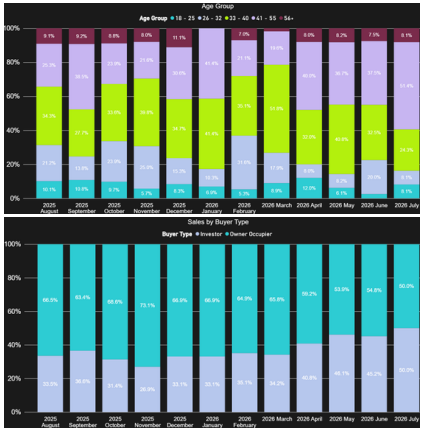
Investors are driving greenfield sales
- Enquiry and reservation levels both eased slightly in July, down 5% and 10%, respectively
- The investor proportion of sales continued to trend up, now sitting at 50%, the highest level in over 12 months
- The proportion of people with India as Country of Birth increased to 29.5%, just below Australia with 36.4%
- The 2026 Federal Budget boosted investor interest in greenfield lot purchases, where subsequent new builds
generating a rental income are eligible for the existing negative gearing arrangements - Property and tax experts have warned that lifting negative gearing benefits on existing builds from 1 July 2027, will not equate to a 1:1 switch to new builds
RPM MARKET REPORT
- SE corridor resale market remains lowest in the state
- SE resale market is still delivering strong price growth
- Retail lot prices have reached a ceiling in the current economic climate
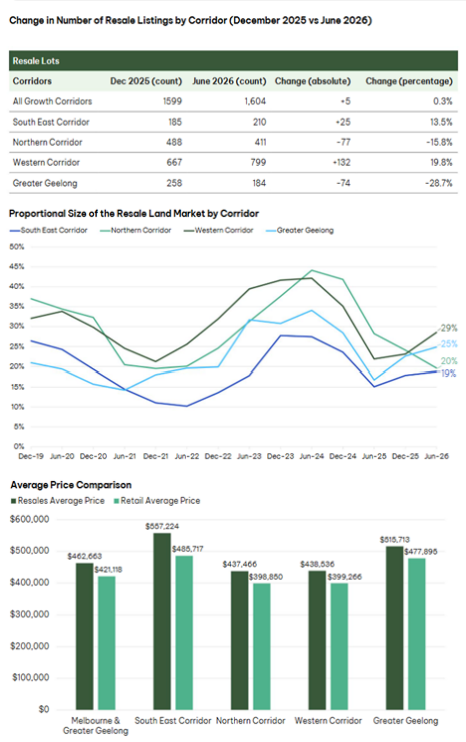
Corridor level movement over the first half of 2026 tells a more interesting story than the market’s overall stability suggests.
The SE corridor made up by the Casey & Cardinia LGAs recorded thesmallest resale market in Melbournein both size and as a proportion of the corridor’s wider land market.
Retail stock has fallen on a $/sqm basis compared to mid to late 2025 levels, as developers stay acitvley aware of shrinking buyer capacity from higher borrowing and building costs.
Resale lots face constraints such as pricing needing to reflect post conditions to avoid a loss or at minimum break even. A pricing led response in the secondary market may start to show at the end of 2026.
The end of 2026 analysis will be key to determining whether structural tax led changes drive further demand into or away from the secondary vacant land market.