
CULTURAL HERITAGE MANAGEMENT PLAN GUIDELINES
First People’s State Relations, July 2026
Industry has been working with First Nations People to improve the CHMP process for RAPs, Sponsors, Heritage Advisors, etc. A better cultural heritage management practice will lead to economic benefits for the private sector and for Victoria. The Guidelines are underpinned by six principles including supporting appropriate investment, land use and development; while all parties act in good faith and make use of new dispute resolution processes prior to
using VCAT. These support the existing principles of of selfdetermination, RAPs acting as the primary decision maker and protecting and manaing Aboriginal heritage. They are only ‘guidelines’ but encourage some processes that were previously mandatory to be conditions of the CHMP.
Early engagement is formalised via discussion of the desktop CHMP. Preservation in situ is the standard with salvage only acceptable as a last resort. Agreement with the RAP for managing low density artefacts can be managed via conditions and contingency (typically was subsurface investigation). Likewise artefact management inductions are now conditions of the CHMP. There are additional channels of dispute resolution available via DSCV and the Victorian Bar.
New Guidelines released in July 2026
- Not mandatory but encourage more collaboration between RAPs, HAs and Sponsors
- Land use and development priorities now a consideration
- Additional dispute resolution channels now encouraged prior to VCAT
- More staged engagement with the RAP required
- Future direction of the CHMP encouraged earlier in the process
- HAs and Sponsors to prepare CHMP conditions for or in consultation with RAPs
- Artefact salvaton a last resort by condition
BATHLA GROUP INTO VOLUNTARY ADMINISTRATION
NSW’ biggest builder collapses owing $3B
Administrators have been brought in to prepare a rescue plan, as construction work is halted and 213 staff have been stood down. 5 lenders have provided $20m so that limited works on a small number of projects tied to the lenders can continue. Bathla, which has 45 construction sites with 2500 partially built apartments in Sydney, collapsed in August with debts of $3.4bn. Bathla has been operating in western Sydney for more than two decades. In many cases half finished apartments have “virtually no value”. In comparison Porter Davis collapsed with 1700 unfinished homes and $71 million in unsecured debts.
Biggest construction company collapse in Australian history
- 2500 partially finished homes across 45 sites
- 213 staff let go
- $3.4 billion in debt
- Been operating in Western Sydney for 2 decades
- Significantly larger than Porter Davis in 2023
CREAMERY ROAD DCP ADOPTED BY COUNCIL
DCP is ‘substantially’ reduced
A Northern Western Geelong Growth Area DCP is awaiting Ministerial approval at $823,000 per ha. It would be the most expensive DCP in the state (source: UDIA, LinkedIn)
Geelong GA DCP adopted
Started at $1.59m p/ha before being reduced to $1.2m pre SAC
RADICAL CHANGES TO VICSMART THIS OCTOBER
4-dwellings now a VicSmart Permit
Labor is spruiking more homes built faster for working families as a pre-election promise, by increasing the number of dwellings that can be approved using a 10-day VicSmart permit from 2 to 4. Under the existing 60-day decision time, these permits can typically run for 6-12 months, including navigating marginal neighbouring objections and dubious Councillor decisions. Projects must still meet the deemed-to-comply standards of the
Victoria’s Townhouse and Low-Rise Code to remain as VicSmart. Heritage controls, environmental overlays, and other planning protections affecting the land will also affect the VicSmart pathway.
VicSmart 4-dwelling permit
- Expansion from 2 to 4 dwellings
- Decision in as little as 10- business days
- Must comply with all the stanardards of the THLRC
- Other planning controls may affect eligibility
- Builds on a 50 per cent increase in townhouse approvals since the introduciton of the THLRC
RPM VIC GREENFIELD MARKET REPORT Q2 2026
Data Centres are rehsaping the market
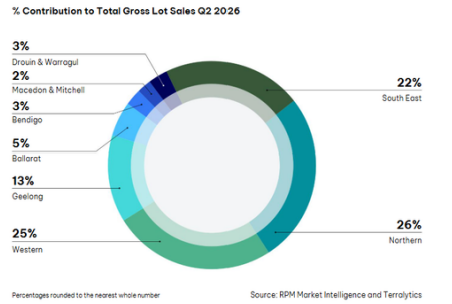
Competition for sites in the greenfield growth corridors and established industrial land for new data centres remains strong. This includes Mickleham (Airtrunk), Cragieburn North, Cambellfield (Zerra DC) and Geelong (NEXTDC). Casey has its first data centre application at Clyde North for Galileo Group (KLMS to do the engineering). This demonstrates Victoria is a destination for capital driven digital infrastructure from all over the world. Victoria has greenfield industrial land at scale and plenty of grid capacity relative to other markets. While this may drive up land prices, some high tech business parks, logistics and commercial development sites see them as anchor tenants. Meanwhile the South East is fairing better than most other markets, while overall sales fall (down 11% qtr, 24% year) and sentiment remains reserved with the prospect of 1-2 interest rate rises. The Western and Northern corridors saw declines of 24% and 15% respectively. The SE cleared titled stock in 147 days compared to 236 in the west being its slowest ever result.
Data centre boom
- Strong demand for greenfield employment land and established industrial land from data centres
- Airtrunk, Zerra DC, Next DC, Galileo all actively developing data centre sites
- Victoria is a data centre destination for international capital
- Putting upward pressure on prices but also seen as being an anchor tenant for new investment
LABOR IS SHUTTING DOWN INFRASTRUCTURE VICTORIA
Expert body to be axed saving $12m
Independent bodies Infrastructure Victoria and Economic Growth Victoria will both be wound up, slashing up to 50 jobs and saving $12 million over the coming four years. However the decision will require legislative changes in the parliament which could take months. The decision was previously rejected by former premier Jacinta Allan. Daniel Andrews established Infrastructure Victoria in 2015 with bipartisan support to take the politics out of massive state spending. Its work will be absorbed by the Department of Transport and Planning.
Infrastructure Victoria chief executive Dr Jonathan Spear said the agency’s impactful advice improved social, economic and environmental outcomes for the state. Dr Spear said 84 per cent of the recommendations in the 2021 30-year strategy had been accepted or implemented. Its role was also advising the government on strategies to reduce costs on its projects.
Others say the decision is not controversial with many of the peak body’s recommendations being ignored by the Labor Government. Opposition transport spokesman Matthew Guy said the Coalition would keep Infrastructure Victoria if elected in November. He said the Suburban Rail Loop showed now was not the time to cut back independent advice.
In 2023 IV released its ‘Our Home Choices’ Report which encouraged increasing infill densities, particularly with 3-bedroom apartments and pulling back on greenfield land expansion.
Infrastructure Victoria to be closed
- 50 jobs slashed and $12 savings over 4 years
- Potentially another $70 million to be cut from ‘consultants’ budget
- Will require legislative changes in parliament
- Introduced by Premier Dan Andrews in 2015
- 84% of recommendations in the 2021 30-year strategy accepted
- Many other recommendations have been ignored
- Opposition to keep IV if wins November election
ALL GROUPS CPI IS STILL RISING
Discretionary spending is still running hot
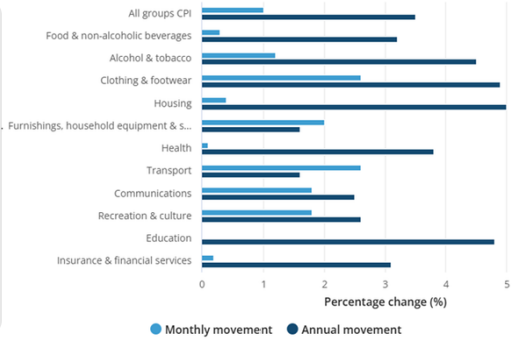
It’s bad news for mortgage holders because consumer discretionary spending is still too ‘hot’, which will likely contribute to a rate rise this September. The ‘wealth effect’ from falling house prices has not affected consumers yet, while unemployment remains at around 4.5%. The build cost of housing is rising at a staggering 5% annually and around 45% since 2021.
Copy this straight into the WordPress visual editor. I fixed “to ‘hot’” to “too ‘hot’”, removed the stray space before the comma, and added “It’s” to the opening, which was missing its apostrophe-s.
Before publishing, check that “this September” is still accurate. Today is 9 October 2026, so September has already passed. You may want “this month” or the next RBA meeting date, depending on what you meant.
Corridor level movement over the first half of 2026 tells a more interesting story than the market’s overall stability suggests.
The SE corridor made up by the Casey & Cardinia LGAs recorded thesmallest resale market in Melbournein both size and as a proportion of the corridor’s wider land market.
Retail stock has fallen on a $/sqm basis compared to mid to late 2025 levels, as developers stay acitvley aware of shrinking buyer capacity from higher borrowing and building costs.
Resale lots face constraints such as pricing needing to reflect post conditions to avoid a loss or at minimum break even. A pricing led response in the secondary market may start to show at the end of 2026.
The end of 2026 analysis will be key to determining whether structural tax led changes drive further demand into or away from the secondary vacant land market.