
$3bn tax fallout
Master Builders Australia, Housing Industry Association, Property Council of Australia, Real Estate Institute of Australia
ALL EXAMINED IMPACTS OF REMOVING
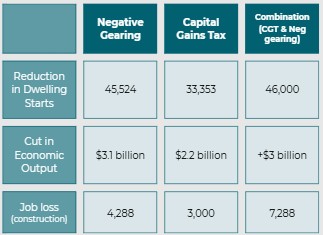
“Falling prices may offer short-term relief for buyers, the longer- term outlook is more severe”
Peak industry bodies forecast the impact of budget changes on housing
Major changes to both CGTD and neg. gear. could wipe out 45,000 new homes
Up to 90% of rentals are 1-2 property investors
Most severe change through negative gearing
Tackle home shortfall & supply chain shocks
UDIA National Housing Pipeline Report
40% of all zoned land for new housing is environmentally or infrastructure constrained. This is reducing Australia’s 5-year dwelling production by 380,000+
homes and recent supply shocks are making it worse. Fuel costs have already added $10,000-$20,000 more per home.
Government is using National Housing Pipeline to stress test, inform & prioritise infrastructure to unlock supply for more viable housing.
Housing is the largest contributor to the Consumer Price Index, rising 7.2% in February 2026.
28% of survey supply requires environmental/biodiversity approvals
17% require Federal environmental approvals
43% of those approvals involve offset requirements
“The opportunity to correct course remains within our grasp, but only if policy and investment settings focus on what can genuinely be delivered, not simply what is theoretically possible.” UDIA National President, Oscar Stanley
Greater Melbourne/Geelong:
- 16,000 hectares of undeveloped unconstrained residential zoned land
- Constrained zoned land holding back 145K dwellings
- Environmental constrained land hold back 79,000 dwellings
- Only 6.26 years of unconstrained residential land supply
- 16% of greenfield land surveyed requires trunk infrastructure unlocking
- Federal/SA partnership for equal water funding and urban renewal grants is expected to unlock 17,000 new homes (7,000 for FHBs)
RISING APPROVALS
Prior to the Middle East Conflict
29,720 approvals in Q3, 6.9% greater than the same period last year. Multi-unit approvals nearly doubled since December & January
(+93.2%) February 2026 = 9,070, highest since June 2018. Victoria had a 2.8% increase in detached house approvals in the 3 months to February 2026.
“The rise in detached house and multi-unit approvals numbers has been on the back of elevated population growth, low unemployment and three interest rate cuts last year.”
“If overseas events are short-lived, oil prices are likely to stabilise. In this scenario, there is good reason to believe that ongoing pressure on inflation and interest rates should subside.
“If overseas events persist, the likelihood increases that the current price shock will feed into future expectations, ongoing inflation and, therefore, even higher interest rates.” Tom Devitt, HIA Senior Economist.
Price shock without the supply shock
- 9,950 approvals in February, the highest since June 2018
- Q3 volume of 29,720, up 6.9% on a year ago
- Multi-unit approvals almost doubled to 9,070
- Confidence follows several quarters of depressed activity
- Doesn’t consider two rate hikes and higher fuel prices
- “Reduce taxes, pause further regulatory changes, and addressing structural shortages of skilled trades,” Tom Devitt, HIA Senior Economist
Infrastructure Proposals
Outlines highest priorities over the next 10 years with 68 proposals.
Based on infrastructure gaps & opportunities across Australia aiming to improve productivity, liveability and sustainability through exploring new transport networks and improving mobility, unlocking housing and creating jobs, helping government know what is needed most by communities.
High Productivity Freight Networks
Grow by 77% by 2050, largest source of Australias greenhouse gas emissions in 2024 at 83%
Ports Capacity & Connectivity
Exported $467 billion 2023-24, accounting for nearly 25% of GDP
High-Capacity Transport
Most daily travel relies on private vehicles, despite need for efficient and reliable public transport
Secure Sustainable Water for Growth
Driest inhabited continent & has highest per capita surface water storage capacity of any country
Delivering Net Zero & Clean Energy Economy
Renewable energy to supply 98% of electricity by 2050
Rail Freight Networks
- Digital signals / controls 2-4Y
- Melbourne intermodal terminal 5-10Y
- OMRE6 5-10Y
Ports Connectivity
- Melbourne airport rail 2-4Y
High Capacity Transport
- SRL East Investment Ready
- SRL future 5-10Y
- High capacity signaling 2-4Y
- Melbourne rail upgrades north 2-4Y
- Melbourne rail upgrades west 2-4Y
- High speed rail future East
Coast 2-4Y Secure, Sustainable Water
- Werribee reconfiguration
Investment Ready - Renewable Energy Zones
SA/Geelong/NSW 2-4Y
Offering property for transmission lines
Craig McIntosh, is in the 40% of 170 landowners in the preferred easement offering his property for VNI West transmission lines. Those refusing survey access face an $800 fine, which could be
$6000 if they end up in court. Proposed 500km high-voltage project, to run through farms connecting renewable energy zones from Victoria to NSW.
Mr McIntosh supports VNI because ‘he has farmed his whole life around a line that was built 60 years ago which helped a region have power as opposed to relying on generators.’ Mr McIntosh would receive $2 million+ in state government compensation over the next 25 years for hosting 10km of line.
“Especially at the moment with rising fuel and fertiliser costs, I’m a big believer that we need different revenue streams to be profitable,”
Brue Hosking affected farmer and Victorian Farmers Federation (VFF) president says the process has lacked consultation and that agricultural farmers are being unfairly treated.
“You can farm under it; I’ve never known anyone to crash into [a tower] or stop farming around them.”
“Agriculture is doing the heavy lifting when it comes to reducing emissions, yet we seem to still be bearing the brunt of every other sector of the economy [that] needs to reduce their own emissions,”
Critics of the proposal, including Bruce Mountain, a Vic Energy policy professor, estimates it could cost $28 billion over the next 10 years, and there are cheaper alternatives.
Addressing the housing crisis
A Report by Blackfort, Archistar and CoreLogic says a forecast shortfall of 106,300 homes over the next 5 years, could be met by secondary dwelling units out of a potential 655,000 backyards Australia wide.
The Report says the target is falling short due to growth of single occupant households, rises in migration alongside financial, trade skill and logistical challenges through the construction industry.
Rent is rising as demand exceeds supply. Granny flats/secondary dwelling units can be transported to site and ready for occupation in a fraction of the time a traditional build takes. They provided research that adding a secondary dwelling unit containing two bedrooms/one bathroom increases the value of an existing home by up to 32%.
As of 2023, Melbourne was predicted to have an undersupply of 23,800 houses over 2023-2027. The Report identifies 229,051 opportunities for secondary dwelling units in Melbourne backyards. The Report says these can support low and middle income earners in targeted industries, e.g. healthcare. 23.3% of sites identified are located in the same suburb as a hospital and 43.5% within 2km radius of train/tram stations.
Melbourne Metro
- Forecast to have a deficit of 23,800 homes to 2027
- 229,051 properties capable of containing a secondary dwelling unit/granny flat
- Equates to 13.2% of all dwelling stock
- 43.5% are within 2km of a train station/tram stop
- Mornington Peninsula, Casey Monash, Knox, Mannington, Boroondara, Whitehorse, lead the capacity opportunities
Challenges:
- Rental unaffordability
- Lack of rental supply
- Constraints due to:
- Time
- Regulations
- Industry shortages
melbourne home buying 1990 vs 2025
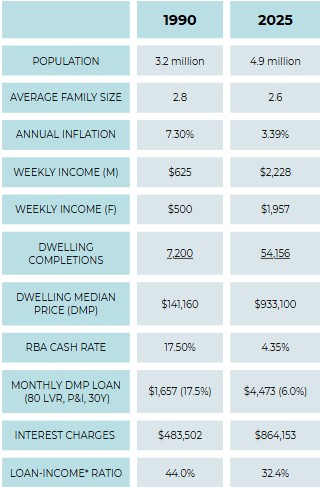
Dispelling the myth about home buying at 17.5% interest rates
1990 began with the RBA cash rate rising to 17.5% (home loans also peaked at this rate), while in May 2025 its
4.35%Loan to income ratios for an 80% LVR home loan to the median dwelling value in 1990, were estimated at a daunting 44% compared to 32% in 2025, for two working adults. This could be even higher in 1990, as was more typically the case where there was only one bread winner in the household
However with median house prices at ~$141K (compared to ~$933K in 2025), households saved hundreds of thousands in total interest. They were also typically paying off the debt sooner, creating even more savings
Verdict: 1990 is the winner, with the size of the principle a bigger burden than the rate of interest
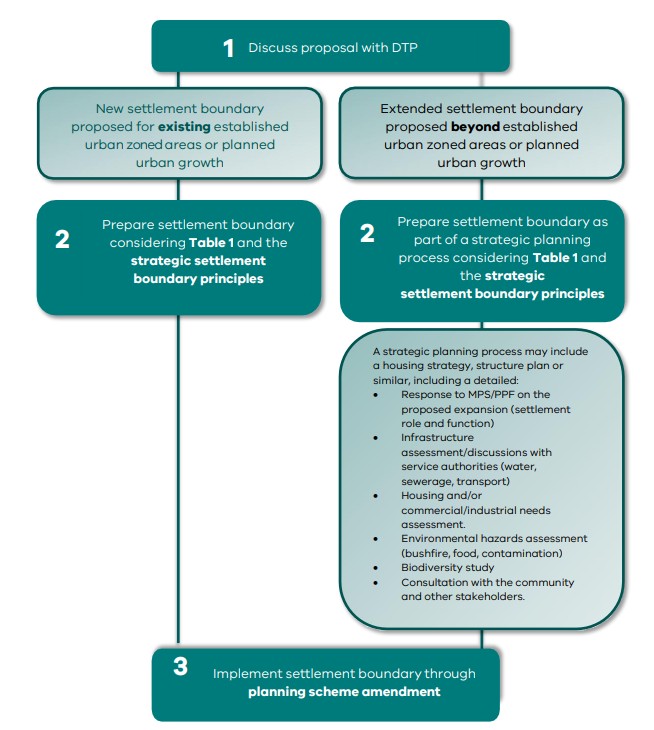
Implementing a strategic settlement boundary (PPN99)
DTP has released a planning practice note in consideration of ‘Strategic Settlement Boundary’ (SSB) planning in regional areas. Setting or amending a SSB requires a planning scheme amendment, but the consent of both houses of parliament is not required.
INCLUDED
RESIDENTIAL:
General residential zone
Low density residential zone
Mixed use zone
Neighbourhood residential
zoneResidential growth zone
Township zone
PUBLIC LAND ZONES:
Public land use zone
Public park and recreation zone
Transport zone
SOCIAL PURPOSE ZONE:
Activity zone centre
Comprehensive development zone
Port zone
Special use zone
Urban growth zone
COMMERCIAL ZONES:
- Commerical zones 1,2,3
INDUSTRIAL ZONES:
- Industrial zones 1,2,3
STRATEGIC SETTLEMENT BOUNDARY PRINCIPLES:
Growth planning & Settlement role
Environmental risk management adaptation
Infrastructure & services
Housing & employment needs
Natural and landscape features
Land use conflict
WHAT IS A SETTLEMENT BOUNDARY:
To show intended limit of urban development for a town/metro area in the planning scheme.
Urban Growth Boundary (UGB):
Metro Melb fringe planning schemes
Protected Settlement Boundary (PSB):
Distinctive Areas & Landscapes
Strategic Settlement Boundary (SSB):
Settlements in regional Vic
Infrastructure Pipeline
The Allan Labor Government is securing the raw materials needed to build more homes, schools and hospitals.
Sonya Kilkenny (Minister for Planning) approved 3 new Strategic Extractive Resource Areas (SERAs) in: Lang Land (Cardinia Shire), Oaklands Junction (Hume City), Trafalgar (Baw Baw Shire).
Safeguarding land for future quarries ensure builders have access to rock and sand resources. Planning controls aim to provide certainty about where quarries should and should not be.
Protect critical resource from being built over as suburbs grow. Ensure homes aren’t built too close to extraction sites. Any new quarries will need to go through the full approvals process.
Developments (Homes, schools, shops) will continue to be carefully assessed near these areas.
“Every home, every school, every hospital starts with rock and sand – we’re making sure the supply is there.” – Sonya Kilknny
Cabinet reshuffle
Next Election: November 28, 2026
NICK STAIKOS: Minster for Housing & Building,
Minsiter for Surburban Rail Loop.
STEVE DIMOPOULOS: Minister for Economic Growth & Jobs,
Minister for Sport and Major Events.
COLIN BROOKS: Minister for Industry & Advanced Manufacturing,
Minister for Defence Industry,
Minister for Skills & TAFE.
GABRIELLE WILLIAMS: Minister for Women & Girls.
ENVER ERDOGAN: Minister for Environment,
Minister for Outdoor Recreation,
Minister for Casino, Gaming & Liquor Regulation.
SONYA KILKENNY: Minister for Violence Reduction,
Minister for Finance,
Attorney-General,
Minister for Planning.
PAUL HAMER: Minister for Youth & Justice,
Minister for Corrections,
Minister for Local Government.
MICHAELA SETTLE: Minister for Regional Development,
Minister for Agriculture.
Next state election is on: Saturday 28 November 2026.
The caretaker period will commence in October. During this time, the government must avoid making major policy decisions, issuing significant contracts, or making appointments that could bind an incoming government.
The Government’s Budget page is here and the Statement of Finances here.